
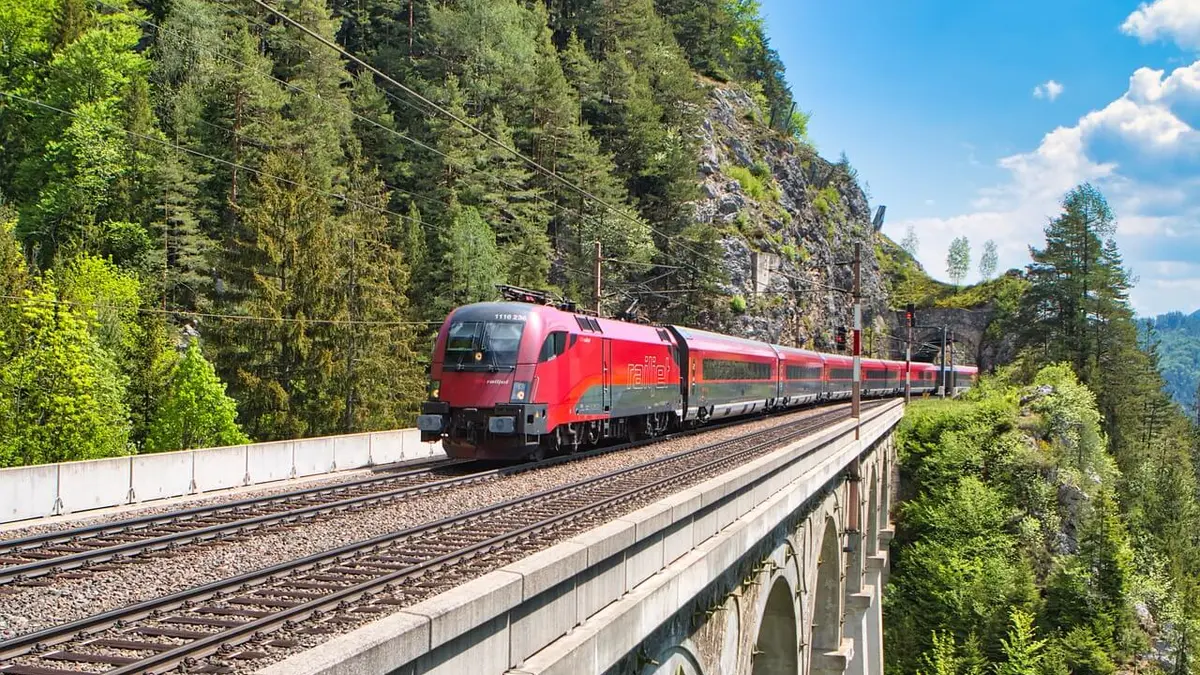
Austria's rail system is well renowned.
The country's public rail operator, ÖBB, runs some of the best-known night routes in Europe, and thousands of people in Austria rely on trains (long-distance and local) to go to work every day.
But even though the country's trains are famous for being a great mode of transport, delays can happen. A recent report from the Agency for Passenger and Passenger Rights (APF) shows that Austria's train services showed "resilience" despite challenges, including extreme weather and construction projects.
It also showed where and when delays happened more often.
READ ALSO: Five Austrian destinations you can reach by train to escape the heat
Which are the least punctual companies?
Among long-distance operators, WESTbahn has emerged as the most punctual company, with 83.7 percent of trains running on time in 2023. However, this is a lower than the previous year's rate of 88 percent.
The drop in performance is attributed to the expansion of the route network to Innsbruck and Bregenz, leading to delays in train handovers from international routes.
In comparison, ÖBB, Austria's national railway, recorded a punctuality rate of 80.3 percent in 2023, down from 81.4 percent the year before. The decline has been linked to several factors, including vehicle shortages, weather disruptions—particularly during the winter onset in December—and ongoing construction projects.
RegioJet, which provides services between Prague, Vienna, and Budapest, recorded the lowest punctuality rate among long-distance operators, at just 64.4 percent. However, this marks an improvement from the previous year, when the company reported 53.7 percent.
READ ALSO: EXPLAINED: How does Austria’s Klimaticket work?
Where can you expect delays?
Punctuality rates varied across Austria's federal states in 2023. Vorarlberg topped the chart with a 96.6 percent punctuality rate, while Upper Austria lagged at 92.7 percent for ÖBB local services.
The following regional punctuality figures reflect the performance of local services, according to the report:
- Burgenland: 94 percent
- Carinthia: 95.8 percent
- Lower Austria: 94.4 percent
- Salzburg: 93.5 percent
- Styria: 95 percent
- Tyrol: 95.9 percent
- Vienna: 92.9 percent
When are trains most likely to be delayed?
July and August recorded the lowest punctuality rates, at around 84 percent, primarily due to a surge in passenger numbers during the summer holiday season.
The onset of winter in December also resulted in a notable spike in delays (with punctuality going as low as 90.6 percent), as heavy snowfall disrupted many services.
What happens if my train is delayed or cancelled?
In general, if you are affected by train delays or cancellations, you have rights in Austria.
You are entitled to 25 percent of the one-way fare of your ÖBB ticket for delays starting from 60 minutes and 50 percent for delays starting from 120 minutes.
However, suppose you use only suburban and regional transport services (Regionalzug, Regional-Express, Cityjet Xpress, or S-Bahn in the timetables) and do not have a ticket that includes main-line services. In that case, you are not entitled to compensation in case of any delay.
According to ÖBB, if your train is cancelled or delayed by more than an hour, you have various options which you can read about in our article on your rights when hit by train and plan cancellations and delays.
READ MORE: What are your rights if your train is delayed or cancelled in Austria?
Comments